The drive east from Tavira: Cacela Velha, the salt marsh and the Guadiana
Updated September 23, 2026 · 8 min read
If you hire a car in Tavira for one day, this is the day. It runs east along the last of the Ria Formosa, turns inland at the Guadiana and follows the river north until the Algarve stops looking like the Algarve. About sixty kilometres out, the same back, and it takes the whole day if you do it properly.
It is also the one direction the railway cannot help with. The Linha do Algarve runs to Vila Real de Santo António on the coast and stops at the river. Everything upstream of that — Castro Marim’s marshes, Alcoutim, the border villages — is road only. That is the argument for the rental, and it is why this route rather than a prettier one to the west.
Getting out of town, and the toll question
Two ways east. The A22, the Via do Infante, is fast and now free: tolls on it were abolished on 1 January 2025 under the law published in the Diário da República on 7 August 2024, which ended charging on the former SCUT motorways that have no equivalent alternative. The concession continues for maintenance and operation, but nobody charges you to drive on it. Ignore any advice — and any desk offer — telling you to buy a transponder for the Algarve motorway.
The N125 is the old road, slower, with roundabouts and traffic lights and the towns strung along it. For this route, take the A22 out and the N125 back; the interesting stops are all off both of them anyway.
Fill the tank on the coast, before you turn inland. We have not counted filling stations on the river road and would not plan the day around finding one.
Cacela Velha: a quarter of an hour, and worth the detour
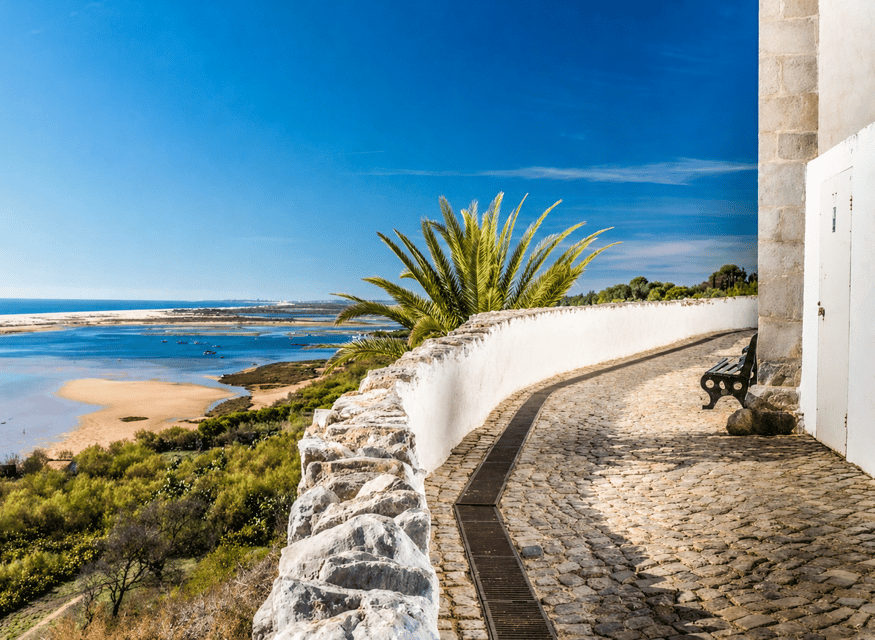
Twelve kilometres east of Tavira, a quarter of an hour, signposted off the N125: a bluff with a church, a fortress, a handful of white single-storey houses and one of the best views in the eastern Algarve — straight down onto the last lagoon of the Ria Formosa and the sandbank that closes it off.
The Câmara Municipal of Vila Real de Santo António describes the Igreja Matriz de Nossa Senhora da Assunção as built in 1518 over the ruins of the earlier medieval structure, and the fortress as a 17th-century work on a site that saw Romans fishing and salting here and Muslims walling it. The fortress is reported to be in use by the Guarda Nacional Republicana; the municipality describes it but publishes no visiting information, so treat it as something you look at from outside. That is fine, because the view is the point and the view is free.
Two honest notes. We could not find an official statement about parking, and the village is a few streets wide; travel accounts consistently report that spaces are scarce and that in summer you leave the car on the approach and walk in. And the cobbles and the slope make this a difficult stop for anyone with mobility problems — the same problem the town itself has, set out in Tavira with limited mobility.
Below the village is Praia da Fábrica, the jetty for the sandbank. Getting across is a short boat hop, not a walk, and it is seasonal. If a beach is part of the plan, read family beaches near Tavira first — a car does not get you onto the sand here any more than it does at Tavira.
Castro Marim: the oldest reserve in the country
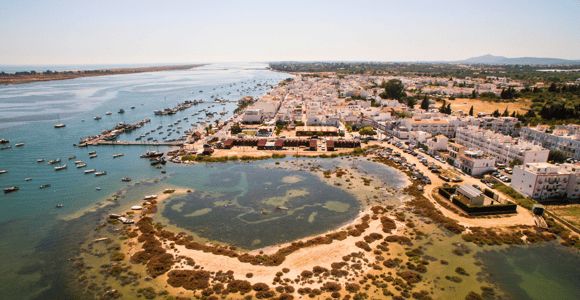
Another ten kilometres east — twenty-three from Tavira in all — and the landscape changes from lagoon to salt marsh. The Reserva Natural do Sapal de Castro Marim e Vila Real de Santo António was created in 1975 by Decreto-Lei n.º 162/75 and was the first nature reserve established in Portugal. It is marsh, salt pans and brackish water where the Guadiana meets the sea, and it is one of the reliable places in the country for greater flamingos, spoonbills, avocets and storks.
This is a stop with a season, and the season is the opposite of the beach one. Winter is when the flamingos and spoonbills are in; spring brings the storks. In August you get heat, glare and fewer birds. If you are here in July, do this stop first thing in the morning or not at all, and take more water than you think you need — there is no shade on a salt pan. Anything medical about heat or sun is a question for a pharmacy, and Portuguese farmácias are good at it.
Above the marsh sits the castle, with the village below it. We have deliberately not printed opening hours or an entry price: the municipality’s own pages moved and we could not confirm a current figure, and a wrong opening time costs you an hour of your only driving day. Check on the day.
The Ponte Internacional do Guadiana carries the A22 into Spain here, and Ayamonte is a twenty-minute detour. Before you take it: driving a rental out of Portugal normally requires the operator’s prior authorisation and a cross-border product, and without it you are outside your own agreement. That, and the rest of the money side, is in excess, deposit and what gets added at the desk.
North to Alcoutim, which is the actual reward
Head north out of Castro Marim on the EN122 and its successor up the eastern edge of the Algarve, then drop onto the M507, the Marginal do Guadiana, which follows the right bank between Foz de Odeleite and Alcoutim. That last stretch is the reason to do this at all: normal tarmac, endless curves, the river appearing and disappearing below you, and almond trees that turn the hillsides pink in late winter. It is not a fast road and it is not meant to be — reckon on roughly forty minutes from Castro Marim to Alcoutim if you take the river rather than the direct route. The Guadiana here is a broad green river with Spain on the far bank, hills on both sides, and villages that see a fraction of the coastal traffic.
Alcoutim is the end point: a small white town on the water facing Sanlúcar de Guadiana across it. There is a passenger ferry between the two — a small boat, people only, no cars — and the crossing has a detail that catches everybody out. Spain is an hour ahead of Portugal. Cross for lunch at half past one and you arrive at half past two, into a Spanish kitchen that is perfectly happy about it; come back at what feels like four and it is three. Check the return crossing time locally before you go over, in whichever country’s clock the timetable is written in.
If you want the river without the driving, there are boat trips up the Guadiana from Vila Real de Santo António. They are a different day, not this one.
The waterfall: plan around it, not for it
Somewhere in your research you will meet the Pego do Inferno, a waterfall and green pool in the hills a few kilometres from Tavira, and it photographs beautifully. Do not build a driving day around it.
It has been closed to the public since 2012, when a fire destroyed the wooden structures that gave safe access. The Câmara Municipal de Tavira drew up a project in late 2019 to rebuild access by walkway elsewhere on the river, but the land is privately owned and the work has not happened; drought and the municipality’s other commitments were both cited. In July 2026 the Portuguese press was still running the story under the headline that there is still no access to the Algarve’s waterfall. Reaching it today means crossing reed beds and private land, and landowners are reported to be unhappy about it.
Worth knowing if you are comparing tours: one of the most-reviewed trips from Tavira advertises a “waterfall stop” with swimming, and its booking page does not name the waterfall. That is not an accusation — operators visit river pools that are not the Pego do Inferno, and one of them has a private arrangement or a different spot. But it is the question to ask the operator before you book, and it is a thing a hire car definitively cannot get you to.
Where the guided tour beats the car on this exact route
Three places, and they are specific.
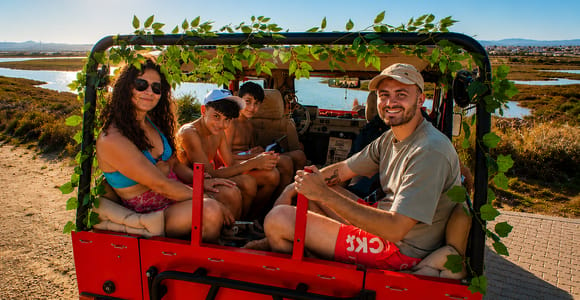
The salt-pan tracks. The working roads through the pans at Tavira, Santa Luzia and Castro Marim are unsealed. We read one large Portuguese operator’s conditions in full and found no ban on unpaved surfaces — but no promise of cover on them either, and a wheel sunk in a salt pan is your excess, not theirs. The jeeps drive those tracks because that is what they are built for. The salt pans and flamingos trips go where a hire car has no business being — and the private jeep tour to Cacela Velha and the Ria Formosa covers roughly the first half of this route with somebody else at the wheel.
Lunch. Portugal’s limit is 0.5 g of alcohol per litre of blood, and 0.2 g/l for drivers in the probationary period and for professional drivers. A long lunch at Cacela Velha with wine and a drive to Alcoutim afterwards are not the same day. Either someone abstains, or you take a food and wine tour and let them drive.
The birds. You can see a flamingo on your own. Knowing that the white bird with the spatula beak beside it is a spoonbill, and why both are there in February and not in August, is what a guide is for. The Tavira salt pans guide sets out which land tours do that properly.
What the day actually looks like
Leave Tavira after breakfast, Cacela Velha by half past nine before the heat and the parking, Castro Marim and the reserve mid-morning, Alcoutim for lunch, the river road back in the afternoon, home before the light goes. In winter that is comfortable. In August, start earlier and expect to be slower.
If you would rather not drive any of it, most of the coastal half is reachable on the railway — Tavira without a car sets out exactly how far that gets you, and Faro, Olhão and Tavira in one day is the version of this day that runs on train tickets. The wider region, including the parts this route skips, is in what to see in the eastern Algarve.
And if you have not decided whether the car is worth it at all, that argument is made properly in do you need a hire car in Tavira. If you already know you do, compare prices before you arrive — we are not a rental company and the booking runs directly with Discover Cars.