Do you need a hire car in Tavira? The honest answer is: probably not all week
Updated September 23, 2026 · 7 min read
Most car hire advice for the Algarve was written for Lagos, Albufeira and the west, where the sights are strung along thirty kilometres of cliff and nothing connects them. Tavira is a different problem. The town is on the railway line, the old town is walkable in twenty minutes, and the beach is on an island — which means a boat, whether or not you have a car parked outside.
So the honest answer is: for a town-and-beach week, no. For the eastern corner and the hinterland, yes. The useful question is not car or no car, it is for how many of your days.
What you already get without one
The Linha do Algarve runs Faro–Tavira–Vila Real de Santo António, and it stops at the towns most people actually want: Faro, Olhão, Fuseta, Tavira, Conceição, Vila Real. Buses fill in Santa Luzia, Pedras d’el Rei and Cabanas. The detail — which route, which stop, and where the last service of the day leaves you stranded — is set out in Tavira without a car, and it is worth reading before you price a rental, because a lot of what a car is sold for here is already covered.
Three things a car does not fix:
- The beach. Ilha de Tavira is reached by boat. Praia do Barril is reached by a causeway and a flat kilometre on foot or on the little train. Terra Estreita is a ferry. A car gets you to the jetty car park, and then you queue for the same boat as everyone else.
- The old town. It is cobbles, one-way lanes and paid parking. You will park on the edge and walk in, exactly as the train passengers do.
- Lunch with wine. Portugal’s limit is 0.5 g of alcohol per litre of blood under the Código da Estrada, and 0.2 g/l for drivers still in the probationary period and for professional drivers. Between 0.5 and 0.8 is a serious offence; from 1.2 g/l it is a crime punishable by up to a year in prison. If the day involves a winery, somebody is not drinking, or nobody is driving.
What changed on 1 January 2025
The A22, the Via do Infante, is the motorway that runs the length of the Algarve. It has been toll-free since 1 January 2025. The law abolishing charges on the former SCUT motorways without an equivalent alternative was published in the Diário da República on 7 August 2024, and charging stopped on the first day of the following year. The concession itself continues to around 2030, but only for operating and maintaining the road — not for charging the people on it.
This matters for two reasons. First, driving Tavira–Faro, Tavira–Vila Real or Tavira–Albufeira no longer carries a per-kilometre cost beyond fuel. Second, a great deal of car hire advice still tells you to buy an electronic toll transponder at the desk for the Algarve, for a fee. For the A22 you do not need one. Toll roads elsewhere in Portugal — the A2 north towards Lisbon, for instance — still charge, so this is a regional fact, not a national one.
Where the car genuinely earns its keep
Everything below is either off the railway line or off the bus timetable, and this is the whole case for hiring:
Cacela Velha and the eastern lagoon. A handful of white houses on a bluff above the last stretch of the Ria Formosa. Reachable, in theory. Reachable and back on a weekday afternoon, in practice, only with your own wheels.
Castro Marim and the Guadiana. The salt marsh reserve, the castle, and the river road north towards Alcoutim. The train reaches Vila Real de Santo António on the coast and stops there; everything upstream is road. This is the drive we would actually make, and it has its own article: the drive east from Tavira.
The Serra do Caldeirão. The hinterland behind Tavira has no meaningful public transport at all. If cork oaks and empty road are what you came for, there is no alternative.
Early starts and late finishes. Any activity beginning before eight in the morning or ending after seven in the evening falls outside the bus timetable. Several of the boat trips from Cabanas start exactly then.
If your list is one or two of those, hire for one or two days from a desk in Tavira or Faro rather than for the whole week. Compare prices before you arrive — we are not a rental company and the booking runs directly with Discover Cars — but compare a two-day rental against a seven-day one before you assume the long booking is better value.
Parking, honestly
Tavira charges for on-street parking in the centre. The framework is the municipal traffic and parking regulation published in the Diário da República, 2nd series, of 3 June 2016, and the enforcement is run under a fifteen-year concession. What we could not find is a current tariff published by the municipality, so we are not going to print a euros-per-hour figure that might be four years out of date. Read the sign on the section you park in and pay at the machine; most Portuguese towns charge Monday to Saturday in working hours and leave Sundays free, but the sign is the authority, not the habit.
The practical consequence is simpler than the price: in July and August you will not park near Praça da República, you will park on the edge of the centre and walk. Factor that in when you tell yourself the car is saving you time.
The answer is different for different people
A family with a toddler or a baby. Here the car wins earlier than the timetable maths suggests, because the failure mode is not lateness, it is a sleeping two-year-old and no way home for ninety minutes. Tavira with kids and the cost of a week in Tavira with kids work through what that actually costs against the train.
Two adults, one week, mostly the town and the island. No car. This is the most common Tavira holiday and it is the one the town is built for.
Anyone with limited mobility. A car helps with distance and does nothing about the surface. Tavira’s problem is cobbles and cumulative walking, not kilometres — see Tavira with limited mobility before deciding a rental solves it.
A cruise passenger on a day call. Do not hire. The risk of a queue at the return desk against a ship that will not wait is not worth it.
Visitors staying out of town, at Cabanas, Santa Luzia or up towards Santa Catarina — a car stops being a convenience and becomes the way home after dinner.
When the guided tour is the better buy
Not out of loyalty to the tours we list, but because of three specific things a rental cannot do.
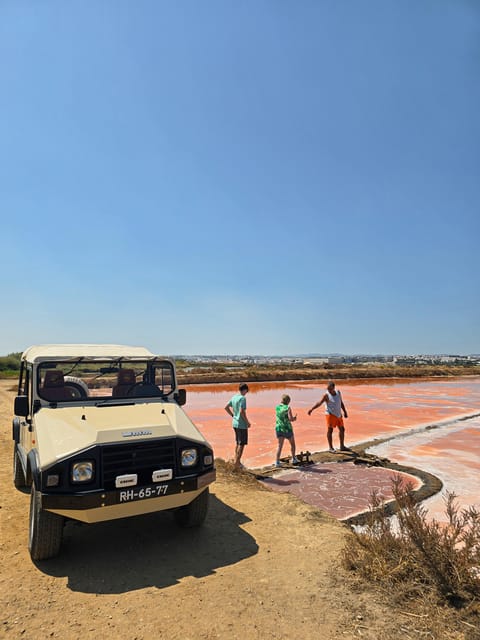
The salt-pan and Ria Formosa tracks are unsealed working roads. We read one large Portuguese operator’s conditions in full and found no ban on unpaved surfaces — but no promise of cover on them either, and a wheel sunk in a salt pan is your excess, not theirs. The jeeps drive those tracks because that is what they are built for. If the pink pans in the photographs are the reason you came, the salt pans and flamingos trips get you onto them and a hire car does not.
Second, wine. A tasting at lunchtime and a drive back are not compatible, and the food and wine tours exist partly because of that.
Third, the bird life. Seeing a spoonbill is one thing; having somebody point out that it is a spoonbill is another, and it is the difference between a nice view and an afternoon you remember. The Tavira salt pans guide goes into which land tours do that properly.
The short version
Hire a car in Tavira if you want the hinterland, the eastern villages or the Guadiana, or if you are travelling with a small child. Otherwise take the train, walk the town, take the boat to the island, and spend the difference on the two or three days you actually need wheels. The money side of the rental — excess, deposit, and what gets added at the counter — is a separate and more expensive subject, covered in excess, deposit and what gets added at the desk.
Everything bookable without a car is on things to do in Tavira; the wider region, most of which does need one, is in what to see in the eastern Algarve.