Tavira with Limited Mobility: It's the Totals, Not the Steps
Updated September 10, 2026 · 7 min read
This article is for anyone who can walk, but not far: with a bad knee, after an operation, at eighty years old, with lungs that work less well in heat. In other words, for a substantial share of all travellers – a group for whom information is otherwise hard to come by.
If you rely on a wheelchair, you’ll find the other questions answered in Tavira in a Wheelchair – that piece covers steps, pontoons and door widths. This one is about something different: distances that are harmless on their own and add up.
The Distances That Shape the Day
Tavira is small, and that’s exactly what’s deceptive. The four distances that matter:
Station to old town: around a quarter of an hour on foot, the last stretch over cobbles. With luggage, this is the first thing many arrivals misjudge; a taxi costs little.
Old town to Quatro Águas, the jetty for the island: a good two kilometres along the salt-pan zone, with no shade. On foot, that’s not a good idea in summer, however well you walk. There’s a car park at the end of the road.
On the island: from the jetty along boardwalks to the sand. Short, but at the end you’re standing on sand, and sand is the most tiring surface there is.
Praia do Barril: a flat, paved kilometre from Pedras d’el Rei across the salt marsh, with no steps and no gradient – or alongside it on the little train for one to two euros each way. This is the beach access that costs the least effort here.
Heat Counts as a Mobility Issue
Nothing grows on the salt pans, the causeways or the island beaches that casts shade. Between midday and half past four, every distance feels half as long again, and there’s nowhere along the way to shelter.
In practice, that means the day here has two workable halves: up to midday, and from late afternoon onwards. Anyone who reads that not as a restriction but as a timetable gets on well in Tavira – the town is built that way anyway, see Half Day Versus Full Day Tours in Tavira.
Where You Can Sit Down
This is the piece of information no guidebook gives you, and it matters more than any sight.
You can rely on the benches along both banks of the Gilão, the garden with the bandstand by the river, and the church squares in the old town. The Ponte Antiga, closed to cars since the 1989 flood, is flat and wide enough to stop in the middle of it.
The most reliable option, though, is cafés: in Portugal, a coffee is the price of a chair for as long as you want it, and nobody hurries you along. If you’re planning a route, plan it from café to café – that’s not a workaround here, it’s the normal way to move around town.
When the kitchens are open and when they’re not is covered in Eating Out with Kids in Tavira; the times apply to everyone, not just families.
Toilets are scarce. The riverside market hall has some, almost all cafés do too, and on the beaches you’ll only find them during the bathing season, and only at the staffed sections.
The Castle, Looked at Honestly
The way up to the Castelo climbs over cobbles, and steps lead onto the top of the wall – the reason for going up in the first place. The walk around up there takes twenty minutes.
If you can’t manage the climb, you miss the view over the telhados de tesouro, the treasure roofs, and there’s no equivalent to be had from ground level. This is the one sight in Tavira where we won’t pretend there’s a way round it. What makes it worth seeing is covered in What to See in Tavira.
The tourist train as an alternative to walking
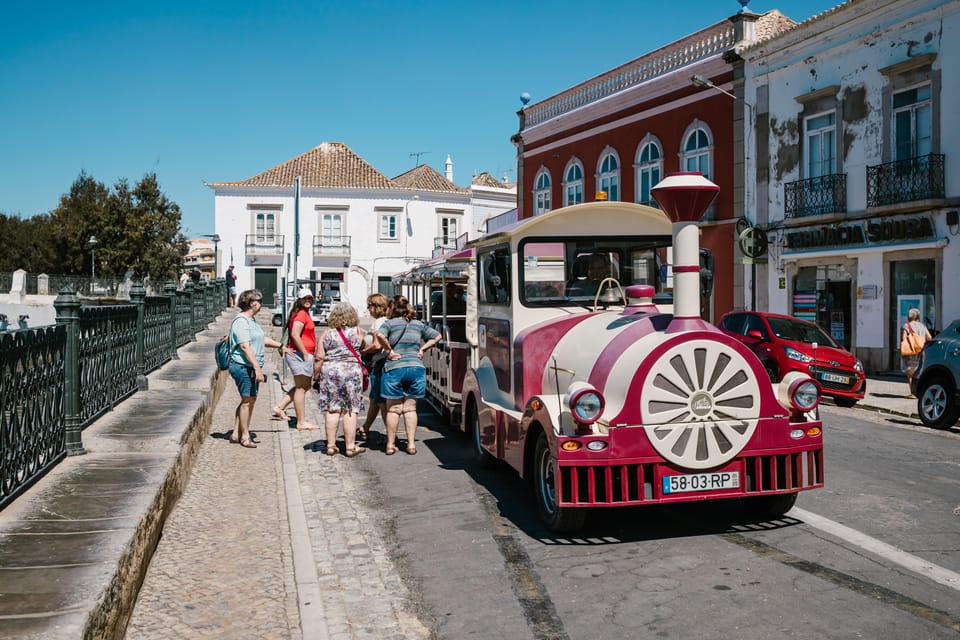
The tourist train through the old town, 45 minutes, from €7, around 200 reviews. It replaces exactly the hour of walking over cobbles that would otherwise cost you half the day. The catch: a step up to board, open carriages, no toilet, and 45 minutes of sitting without getting off.
The other formats, sorted by effort required:
- Tuk-tuk tour through the old town and salt pans, 2 hours from €55: private, seated, stops wherever you like. Step up to board.
- Off-road tour to Santa Luzia and the salt pans, two and a half hours from €67: reaches places that are out of reach on foot. Ask the operator about step height and boarding assistance.
- Boat trip through the fishing villages, 3 hours from €34: seated, calm, on the lagoon. The hurdle is boarding via the floating pontoon, not the trip itself.
- The six- and eight-hour tours on foot or by bike are ruled out. That’s not a question of stamina, but of the distances involved and the lack of any way to turn back partway through.
What to check before booking
As of 10 September 2026, the short descriptions of the 22 activities displayed on this site provide insufficient detail on walking distances, seating and gradients to plan reliably. Some stops are mentioned, such as the octopus route’s lunch stop. Short descriptions do not replace full operator information.
Which is why there’s one question that’s worth more before booking than any other:
How many metres do you walk between stops, on what surface, and for how long are you on your feet?
It forces a description rather than a yes. And it separates the tours where you sit and watch from those where the vehicle is only the taxi between two walking rounds. Ask in writing, and the answer ends up in the booking confirmation.
When Tavira Is the Right Choice
For limited walking distances, this coast is better than the western Algarve, and the reason is geological: there are no cliffs here. No steps down to a cove, no cliff paths, no climbing up and down. The town is flat, the routes are short, the water is calm.
What it doesn’t have is shade or easy access to the sand. Anyone who plans around that – mornings outdoors, afternoons in a café, the beach via Barril rather than by boat – gets more freedom of movement here than in almost any other place on this coast.
What’s worth seeing further afield is covered in What to See in the Eastern Algarve. What’s bookable, by type: Tavira Old Town Tours, Ria Formosa Boat Tours, Salt Pans and Flamingos and the full line-up at Things to Do in Tavira.