Eating with Kids in Tavira: the Afternoon Gap, and What the Trips Actually Include
Updated September 10, 2026 · 6 min read
The hardest part about eating in Portugal isn’t the food. It’s the clock.
A child who’s hungry at half past five runs into a town where no kitchen is working at that hour. Once you’ve grasped that, you plan the day differently – and everything else is easy, because almost every place here is happy to have kids.
The afternoon gap
Lunch is cooked from roughly half past twelve to three. Many kitchens then close and don’t reopen until around half past seven; by eight it’s busy. In between lie four hours where hot food is only found at the places that stay open all day – and on the eastern Algarve, there are very few of those.
Three ways through the gap:
Eat a hot lunch at midday. The dish of the day is the cheapest plate on the menu, and at one o’clock a child can still take it in.
Use the pastelaria as a stopgap. Cafés are open in the afternoon, and a piece of cake at five pushes dinner back by two hours – exactly the two hours that would otherwise be missing.
Eat early in the evening and take the menu as it stands at half past seven. Whoever sits down first gets the table they want and doesn’t have to wait.
What ends up on the bill without you ordering it, and why fish is charged by weight, is covered in What a Week in Tavira with Kids Costs. Those are the two things that really drive up the cost of a family week.
What the trips actually include
Among the 22 activities displayed on this site on 10 September 2026, nine short descriptions mention food, a tasting or a meal stop; the other thirteen do not. A mention does not always mean food is included in the price. Missing information does not prove that nothing is provided. Check food and water arrangements before booking.
The nine:
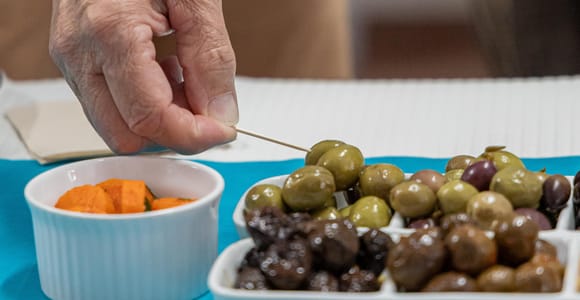
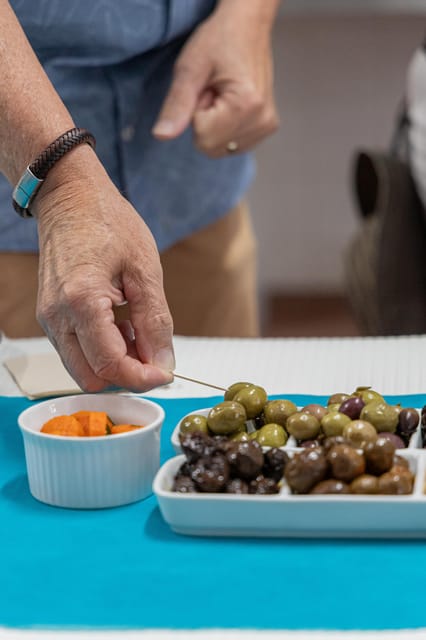
- Table-olive factory with tasting, 1.5 hours, from €29. Olives, olive oil, jam, bread, cheese, honey, plus wine or lemonade – the alternative is stated in the description, which is why this is the one tasting that works with kids.
- City tour with chocolate tasting, 1.5 hours, from €49. The second half stops at a chocolate workshop.
- Family treasure hunt, 2 hours, from €36. Includes a sweet surprise and a certificate.
- Octopus route from Cabanas, 4 hours, from €35. According to the description, there’s a stop for lunch in Santa Luzia – a stop, not lunch included. What the meal costs is a question for the operator before you book.
- Cycling day from Tavira to Olhão and back, 8 hours, from €120. Meals are included according to the short description.
- Jeep tour with wine and tapas, 3 hours, from €83. A glass of wine and a tapa to finish; this one is for the adults.
- Santa Luzia and salt pans jeep tour, 2.5 hours, from €67 per person. The short description mentions an olive tasting.
- Private sailing yacht with tasting, 4 hours, from €750 per group of up to 10. The activity is assigned to Cacela Velha; check the exact jetty before booking.
- Sunset Dinner in Tavira, 3 hours, from €575 per group of up to 10. The short description mentions a sunset dinner; check the menu and inclusions with the operator.
For everything else: water, fruit and something savoury belong in the bag. On the boat trips there’s a second question no description answers – whether there’s shade and a toilet on board. Ask both beforehand; more on that in Boat Trip with Kids: What Age.
On the island, there’s only something in season
At the managed sections of the island beaches, a bar and toilets are set up in summer, and at Praia do Barril there are also places to eat by the anchor cemetery. Outside the bathing season none of that is there, and the way back to the nearest café is a ferry ride away.
That sounds obvious, and it’s the most common mistake of the first holiday day: heading to the island at half past ten with two kids and no water, assuming something will be there. In July, it is. In October, it isn’t.
The market is a morning thing
The riverside market hall is the best place to buy supplies for a day on the island – fruit, bread, cheese, all in five minutes. It is, however, a morning-only institution: turn up at four and the stalls are shut. On Sundays, don’t bother going at all.
For anything later, there are the supermarkets on the edge of town, and those need a car or a fifteen-minute walk.
What kids eat here
Fish is the obvious choice, and octopus from Santa Luzia is on every second menu. Kids who want nothing to do with it get chicken, rice and chips everywhere, and nobody bats an eye. Half portions for children are common – you have to ask for them, as they rarely appear on the menu.
Tap water is safe to drink; many people buy bottled water anyway, because on the coast it tastes of chlorine. For a beach day, a frozen bottle from the holiday flat’s freezer is the most useful thing you can bring: it thaws by midday and keeps the rucksack cool until then.
Where to take a break
In the midday heat, the sand is no place for a break. What works:
The lanes of the old town stay cool because they’re narrow – between two white house walls it feels about ten degrees cooler than on the open waterfront. The garden with the bandstand by the river has trees and benches and is the only shaded spot in the town centre where kids are free to run around. And the Centro Ciência Viva is indoors, air-conditioned and costs from €9 – worth an hour as a programme, but above all a cool room with a toilet.
What isn’t a break: the loop around the salt pans. No shade, no kiosk, no shortcut. Anyone who sets off there with kids at two o’clock has lost the afternoon. What there is to see at the salt pans, and when to go, is covered in What to See in Tavira.
The day that doesn’t work
Beach until four, then the old town, dinner at seven. It sounds sensible and ends with a child asleep at the table at half past seven while the starters are still arriving.
The day that works runs the other way round: out early, a hot lunch at midday, a siesta at the flat, out again from five. Plan it this way, and you won’t need a single restaurant in Tavira that cooks at six.
How this differs by age is covered in Tavira with a Toddler and Tavira with School-Age Kids. Tastings and cooking trips are collected under Food and Wine Tours, trips on the lagoon under Ria Formosa Boat Tours, and the full line-up under Things to Do in Tavira.