Tavira with School-Age Kids: The Age Everything Adds Up
Updated September 10, 2026 · 6 min read
With a toddler, Tavira is a beach resort with a bit of town attached. Between six and twelve, that flips: suddenly everything that used to be too long, too dark or too complicated to explain starts to work.
The short version: this is the age at which Tavira gives you more than its sand.
The camera in the water tower – now the right way round
The Camera obscura in the old water tower is a dark chamber where a mirror system projects a moving image of the town. Someone gives the demonstration, it lasts just under a quarter of an hour, and the room is cramped and quiet.
For a toddler, it’s unsettling. For an eight-year-old, it’s the moment a physics claim becomes visible: out there a car is driving, and in here it’s driving across a table. Children who’ve just covered optics at school ask questions afterwards that adults can’t answer.
Getting up is a tower, not a ramp. Anyone who isn’t steady on their feet won’t make it up there – there’s no lift.
What else works in town
The Centro Ciência Viva, single ticket from €9, a good hour and a half. The building is built exactly for this age: hands-on maths and physics stations, no display cases. What a four-year-old just pokes, a ten-year-old understands – and tries three times.
The treasure hunt through the old town, around €36, about two hours, with puzzles, a sweet and a souvenir at the end. It works from about six upwards, and it works better with two children than with one: solving puzzles against each other holds attention longer than solving them alone.
The tourist train, 45 minutes, from €7. Honestly, at this age it’s no longer an experience but an orientation exercise. As a first lap on arrival day, though, it’s still worth the money, because afterwards everyone knows where the river is and where the castle is.
The old bridge. It’s called Ponte Romana and isn’t actually Roman – the current structure is considerably younger, but the name stuck. No car has driven across it since the 1989 flood. It’s one of the few places in Portugal where you can let a child run ahead without a second thought.
The beaches: the long way there works now too
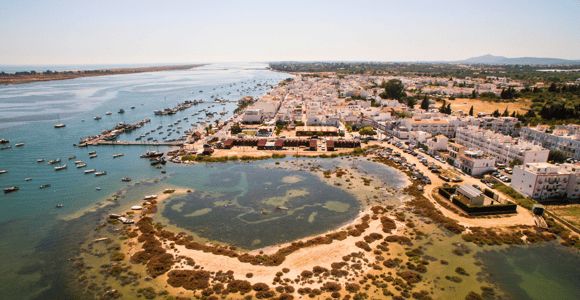
Praia do Barril remains the simplest choice, and at this age the way there becomes part of the outing: from Pedras d’el Rei across the causeway, then a flat kilometre over the salt marsh. On foot, a good quarter of an hour, or by the narrow-gauge little train for one to two euros each way.
At the end lies the anchor cemetery: over a hundred old anchors, lined up in the dune sand. For six-year-olds it’s a climbing frame, for ten-year-olds it’s a story – the anchors belonged to the tuna fishing fleet that anchored its nets here until the 1960s. Tell that story beforehand and you get twenty minutes of genuine interest instead of two.
On Ilha de Tavira, reached by ferry from Quatro Águas, lies the busiest stretch: in the swimming season with a bar, toilets and lifeguards. The crossing takes under ten minutes; the queue at the jetty in August takes longer.
And the real toy of this coast is the tidal channels at low tide – knee-deep, warm gullies between the sandbanks. With a diving mask you’ll find crabs, hermit crabs and gobies there. A snorkel is a better investment than any beach toy.
What holds for every age still applies: channels with a current run between the sandbanks, and they can’t be spotted from above. And the tide comes back faster than it took to walk out.
Which boat trip suits this age
Now it’s allowed to be longer. The boat trip through the fishing villages of Santa Luzia and Cabanas, from €34 and around three hours, stays inside the lagoon – calm water, a guide who shows the traps used for catching octopus. That holds up at this age.
The octopus route from Cabanas, from €35, takes four hours with a lunch stop in Santa Luzia and a final stop in Terra Estreita. Four hours is a lot for a six-year-old and just right for an eleven-year-old – that’s the range that makes this age group so tricky.
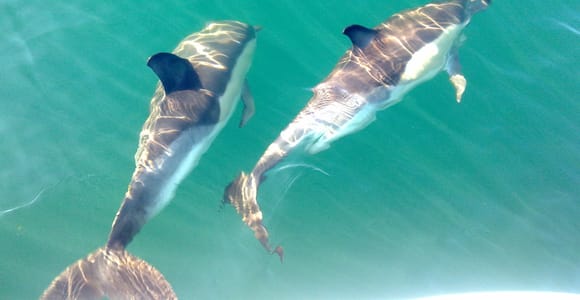
The dolphin trip from Cabanas, from €38 and two and a half hours, leaves the lagoon. Out there the water is different, and this tour’s reviews, at 3.6 out of 5, are lower than those of the two lagoon trips described here (octopus route: 3.9/5; fishing villages: 4.8/5). Wild dolphins aren’t a guaranteed feature, just a possibility. Prepare the child for that beforehand and you’ll spare yourself the return journey with a disappointed child.
None of these descriptions states a minimum age. What each operator sets is on their booking page – the questions worth asking beforehand are in Boat trips with kids: what’s the minimum age.
Bike instead of car
The hinterland around Tavira is flat, and the Ecovia do Litoral, the coastal cycle path, runs right through it. The stretch between Tavira and Santa Luzia is short, level and mostly away from the road – for children who can ride safely, the nicest way to reach the fishing village.
Another guided option is the e-bike tour to the salt pans, from €69, around three hours. Its short description gives the route from Quinta da Ria Golf Resort to Tavira and back along the Ria Formosa salt pans; it does not establish a ride to Santa Luzia. Check frame sizes and children’s participation conditions with the operator beforehand.
Where this age hits its limits
The salt pans on foot. No shade, no kiosk, and the flamingos stand so far away that without binoculars they stay pink streaks. With binoculars it’s birdwatching; without them, a walk through nothing.
A day that adds up
Morning: the little train to Barril, tidal channels and anchors, back around one. Afternoon: an hour and a half at Ciência Viva if it’s hot, otherwise the treasure hunt. Evening: across the old bridge.
Where younger siblings fit in is covered in Tavira with a toddler and Tavira with a baby; the overview across all age groups is in Tavira with kids. What the town itself has to offer is in What to see in Tavira. Bookable options by type: Ria Formosa boat tours, Salt pans and flamingos, Tavira old town tours and Things to do in Tavira.