What to see in Tavira: a town with no beach of its own – and why that's the point
Updated September 10, 2026 · 8 min read
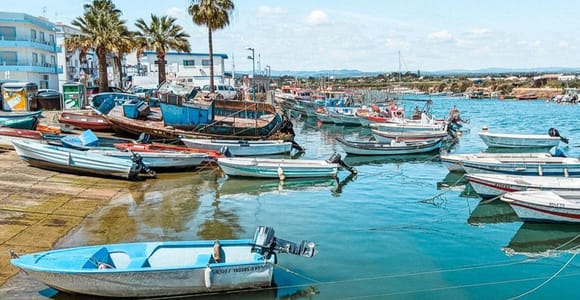
There’s one thing you need to know about Tavira before you book the hotel: the town has no beach. It sits on a river, two kilometres from the coast, and what looks in photos like endless pale sand actually lies on an island offshore. You can only get there by boat.
That sounds like a drawback, and it’s the reason Tavira looks so different from Albufeira or Praia da Rocha. Because a lagoon sits between the town and the sea, nobody could ever build a row of hotels along the waterfront. The old town has therefore stayed an old town: houses, washing lines, a market whose customers actually live here.
If you want a week of sun loungers right outside your room, this stretch of coast is the wrong choice. If you want a town that isn’t empty in the evening, it’s the right one.
The two riverbanks, and the bridge that isn’t Roman
The Gilão splits Tavira into two halves, and the older half is the one with the castle. They’re connected by the Ponte Antiga, which everyone calls the Ponte Romana – seven stone arches, about 86 metres long and six and a half metres wide.
There’s little Roman about it. An ancient bridge probably once stood on the same spot; what’s there today dates from medieval times and has been rebuilt several times, most recently after the severe flood of December 1989, which badly damaged two arches and a pier. No cars have crossed it since – the bridge now belongs to pedestrians and cyclists. That’s the real gain: you can stop right in the middle of it.
The best view of the house fronts isn’t from the bridge itself, but from the riverbank downstream, just before the market hall. In the morning the sun falls on the east side, in the evening on the west – if you’re photographing, decide first which façades you want.
Castle, church, rooftops
The Castelo isn’t a castle visit in the usual sense. Of the Moorish fortification, stretches of wall and two towers survive, and a well-kept garden now fills the space between them. Walking the top of the wall takes twenty minutes, and that’s the reason to go up: from there you see the rooftop landscape Tavira is known for.
These roofs are called telhados de tesouro, “treasure roofs”. They’re small, four-sided pyramid roofs, often several side by side on a single house, one over each room. Where the shape comes from is disputed – Moorish influence, Eastern trade routes, or simply a local carpentry tradition. What’s certain is that they are found almost nowhere outside this corner of the Algarve and that you can barely see them from ground level. Hence the climb.
Right next to it stands the Igreja de Santa Maria do Castelo, built in the 13th century on the site of the main mosque and altered several times since. It’s usually open in the morning and late afternoon, with a break at midday; the hours vary, and different ones apply on public holidays. If you only have one window, go in the morning.
Tavira likes to advertise that it has 37 churches. That’s true as a number, but it says little: most are small, and many only open for services. Try to tick them all off and you’ll spend two days facing locked doors. Two or three are enough, and the Igreja da Misericórdia, with its Renaissance portal, is the one not to skip.
The camera in the water tower
The former water tower dates from 1931. According to the Tavira Eye operator, the Camera Obscura opened in 2004. A mirror and lenses project a live view of the town inside the darkened building; it is not a prerecorded film.
The operator describes approximately thirty minutes per demonstration. Published hours and prices are subject to change, and unsuitable weather can lead to closure. Confirm a session before making a special trip; being indoors does not make it a guaranteed rainy-day activity. Our Camera Obscura visiting guide explains the published tariffs, age guidance and access questions.
The beach is a boat ride away
Now for the sand. Off Tavira lies the Ilha de Tavira, a narrow sandbank island that’s part of the Ria Formosa. There are three usual ways across, and they’re not equivalent.
From Quatro Águas, the jetty at the end of the road behind the salt-pan area: the shortest crossing, taking under ten minutes. The jetty operates year-round; in summer, boats run roughly every half hour, in winter only sporadically. The crossing last cost around €1.20 one way and €2 return, half price for children aged 4 to 11, free for toddlers – as of September 2026, and the notice board at the jetty is always right, not this article.
Via Pedras d’el Rei to Praia do Barril: no boat here, but a causeway followed by a flat kilometre across the salt marsh. You can walk it in a quarter of an hour or ride the little train that trundles alongside the path for one to two euros each way. At the end lies the anchor cemetery: over a hundred rusting anchors lined up in the dune sand, remnants of the tuna-fishing operations that worked here until the 1960s. This is the spot people can still describe years later.
From Santa Luzia to Terra Estreita: the quietest of the three beaches, because the fewest people know about it. The island is only about fifty metres wide there – lagoon on one side, Atlantic on the other.
What holds true for all three: during the bathing season, the staffed sections have a bar, toilets, a first-aid post and lifeguards. Outside the season, there’s sand, wind and nothing else. And shade doesn’t grow there – if you don’t rent a parasol, you don’t have one.
The water is warmer than on the western Algarve, around 21 degrees in late summer, and it shelves gently. The trade-off is the tides: at low tide there can be a hundred metres of sand between the jetty and the waterline.
Santa Luzia, the salt pans and the flamingos
Santa Luzia, four kilometres to the west, calls itself the capital of octopus, and for once that’s not just marketing: clay pots and plastic traps used to catch the octopus are stacked along the quay wall. It smells of harbour, not of promenade.
Between the town and the sea lie the salt pans – rectangular basins where salt is still harvested today and where flamingos gather during the winter half of the year. They’re shy and keep their distance; without binoculars, all you see are pink streaks. If you want a closer look, take a guided trip, by off-road vehicle or by bike; the options are listed on the category page Salt pans and flamingos.
A word of warning about the walking trail around the salt pans: there’s no shade, no kiosk, and in summer no bearable time of day out there at midday. Go early or late, otherwise not at all.
What Tavira doesn’t have
So nobody arrives with the wrong picture in mind:
There are no sea caves and no cliff coastline here. The Algarve’s well-known caves lie farther west.
The catalogue displayed here includes a dolphin trip, departing from Cabanas de Tavira. Dolphins live off this coast, but the lagoon isn’t their territory; the boat heads out to open water.
And there’s no nightlife in the sense of bars still packed at three in the morning. In the evening, people sit by the river, eat late, and go home.
How much time, and how to get here
Half a day is enough for the old town. With the island, Santa Luzia and a boat trip, Tavira fills three days without feeling stretched. If you’re staying longer, add the neighbouring towns – what’s there, we’ve covered in What to see in the eastern Algarve.
From Faro Airport it’s around 29 kilometres by rail. The regional train takes about 37 minutes, runs many times throughout the day and costs a few euros; the station sits on the edge of the old town, about a fifteen-minute walk away. A hire car isn’t necessary for Tavira itself, and in the old town it’s more of a problem than a help.
If you want to see what’s bookable, you’ll find the boat trips under Ria Formosa boat tours, the town tours under Tavira old town tours, tastings under Food and wine tours, and the full range under Things to do in Tavira. If you’re travelling with kids, it’s best to start with Tavira with kids – the order of days is different there.