Tavira with a pushchair: which wheels actually work here
Updated September 10, 2026 · 6 min read
A pushchair is neither an obstacle in Tavira nor a given. It’s a decision best made before you pack – because which pushchair comes along decides more than any day’s planning does.
The wheels are the whole story
The old town is paved with calçada portuguesa: hand-laid limestone cobbles, gaps between them, the whole surface rippled by decades of wear. It looks good, and it’s the surface that small, hard wheels fail on.
A compact travel buggy with wheels the size of your palm rattles here badly enough to wake a sleeping child. A pushchair with larger, air-filled wheels and suspension rolls straight over it. If you have the choice, take the bigger one – the distances are short, and the boot space is the smaller problem.
That’s true for the lanes. On the riverside roads, the question doesn’t matter.
The town’s pushchair map
Rolls well: both riverside promenades along the Gilão, the Ponte Antiga, which has carried no cars since the 1989 flood, the market hall and the way there, the garden with the bandstand.
Rolls with effort: the lanes between Praça da República and the church – cobbles, narrow pavements in places, kerbs without a continuous dip. Manageable, but not a pleasure.
Doesn’t roll: the climb up to the castle and the steps onto the top of the wall. What’s up there and why it’s worth the climb anyway is covered in What to see in Tavira.
Arriving by train: the station sits on the edge of the old town, the walk into the centre takes around fifteen minutes and ends on cobbles.
The ferry: the pushchair gets folded up
The crossing to Ilha de Tavira runs from Quatro Águas, over a floating pontoon and into a small boat. Between the pontoon and the boat’s edge there’s a step, and its height depends on the water level. The pushchair gets folded up for this and handed aboard.
That’s a moment where a third hand would help: child, bag, pushchair, a boat that’s rocking. With a carrier, the same moment takes seconds – the reason we recommend a carrier in Tavira with a baby.
We’re not aware of any staffed place to leave a pushchair at the jetty. If you’d rather not bring it along, leave it in the car – the car park is at the end of the road.
The one route where the pushchair wins
Getting to Praia do Barril needs no boat. From Pedras d’el Rei, a causeway crosses the lagoon, followed by a flat, paved kilometre across the salt marsh, with no steps and no incline, running alongside the narrow-gauge railway.
You can push this route in under fifteen minutes, even with a fully loaded pushchair. Whether an assembled pushchair fits on the little train depends on how busy it is and on the staff – folded, more likely; in August, less so.
At the end stands the anchor graveyard, wooden boardwalks lead over the dune, and after that it’s sand. No pushchair rolls on sand, not even one with big wheels. The last stretch gets carried.
Which beach suits which age is covered in Family beaches near Tavira.
The route past the salt pans: flat, but only early
Between the town and the water lie the salt pans, and the paths between them are causeways: wide, flat, without a single step. On paper, it’s the best pushing route in the area, and in the winter half of the year the flamingos are there.
The catch appears in every one of our Tavira articles, because it can’t be planned away: there’s no shade out there, no kiosk and no shortcut back. With a child in a pushchair, that’s not a good idea between ten in the morning and five in the afternoon, and in July not even at ten any more.
Go early, and you get an hour when the light is low and the path is empty. What there is to see there is covered on the category page Salt pans and flamingos.
What the operators say about it
We read the short descriptions of the 22 offers displayed here in all six languages (as of 10 September 2026): none mentions pushchairs, buggies or storage for them. This does not establish whether an operator allows them; check the participation terms or ask directly.
What can be worked out from the type of vehicle, and what you should ask:
- Boat trips: folded up on board, which should work almost every time – but where it sits during the trip is the question.
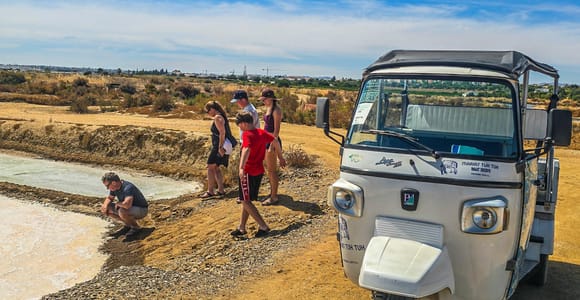
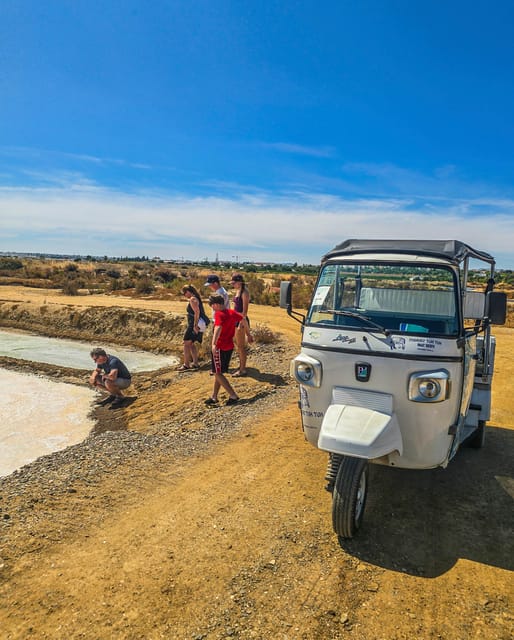
- Tuk-tuk and tourist train: open vehicles with a step up and bench seats. A folded buggy might fit next to the bench; a large pushchair won’t.
- Jeep tours: a high step up, boot space available, but limited.
- Tastings and guided walks on land: here the only question is whether the entrance has steps.
The question that actually gets you a useful answer isn’t “Can a pushchair come along?” but: Where exactly does it sit during the tour, and do we get off partway through? Best asked in writing, before you book.
How long each format takes is covered in Half-day versus full-day tours in Tavira.
Napping in the pushchair, and why it’s hard here
The midday nap in a pushchair is the toughest exercise on this coast. No trees grow on the island beaches; a pushchair in the sun gets hot even with a cloth over it, and a cloth over the hood traps the air even more.
The three places where it works: the shaded lanes of the old town, the riverside garden under the trees, and the covered market hall in the morning. All three are in town, not at the beach – one more reason to spend the afternoon away from the sand anyway.
When to eat here and where to sit in between is covered in Eating out with kids in Tavira.
The short answer
Take a pushchair with big wheels, plan the riverside roads as your main route, expect to fold it and carry it at the ferry, and bring a carrier along as well for beach days. Then Tavira with a pushchair is an easy place – easier than any resort with a cliff and steps down to its cove.
Bookable by type: Ria Formosa boat tours, Tavira old town tours, Salt pans and flamingos, and the full range under Things to do in Tavira.