Tavira’s Roman bridge: what the name gets wrong
Updated September 12, 2026 · 6 min read
The bridge across the Gilão is one of Tavira’s easiest landmarks to recognise and one of the easiest to misdate. “Roman bridge” is the familiar name. It is not proof that the masonry in front of you is Roman. If you come expecting a surviving Roman engineering monument, the label has already sent you in the wrong direction.
Come instead to understand how the two riverbanks fit together. The bridge works particularly well as a short stop before a guided walk: you can see the town’s geography before someone starts explaining its history. You do not need to turn it into a separate half-day attraction.
A name is not an archaeological conclusion
The municipality’s account of the Ponte Antiga distinguishes the widespread idea of a Roman origin from the first documentary references, which appear in a medieval chronicle. It also records a collapse in 1655 and reconstruction completed in 1657, giving the bridge its present appearance and seven arches.
The careful answer is therefore that a Roman origin is not established by the name, while the visible bridge has a documented history of rebuilding. “Entirely Roman” is too strong; so is pretending that a modern photograph settles everything about earlier crossings at this location. When you read a sign or hear an explanation, listen for the difference between evidence, tradition and an attractive story.
You do not need an architectural vocabulary to apply that distinction. Ask which part is being dated: the crossing, an earlier structure, a rebuilding campaign or the stones you can see today. Those are not necessarily the same answer.
Look from the riverbank before crossing
Start with a view from the bank. From the bridge deck you experience the crossing, but you cannot easily read the sequence of arches beneath your feet. A position slightly away from the end is more useful for seeing how the structure spans the water. Choose your place according to available space, rather than blocking the approach for a photograph.
Then cross slowly and compare the town on either side. Use Praça da República and the castle hill as your reference points when orientating yourself. This small exercise is more helpful than memorising a list of streets: afterwards you can decide whether to climb into the historic quarter or continue along the water.
If you enjoy photography, take one wider image that includes the buildings as well as the bridge. A close crop of the arches may be attractive, but it says less about why this particular crossing matters to Tavira. You can return later if the light is not what you wanted; there is no reason to force the rest of the day around one photograph.
How much time to allow
Our suggestion is fifteen to thirty minutes for a look from the bank, a crossing and a pause. That is a personal planning allowance, not an official visit duration. A photographer may want longer; someone using it simply to reach the other bank will need much less.
Avoid confusing “quick to see” with “unimportant”. The bridge is useful precisely because it connects the rest of your visit. You can spend a short time here and still leave with a clearer picture of Tavira than after an hour of wandering without reference points.
For the next stop, choose either the church walk or a longer riverside pause. Doing both immediately is optional. If you are waiting for a booked tour, follow its actual meeting-point instructions; “near the Roman bridge” is not precise enough to locate a guide.
What a walking tour adds
The local catalogue dated 11 September 2026 lists “From Moors to Myths”, tour 1142299, at €16.50 per person for one hour, with 40 reviews and a score of 4.9. Those figures describe the tour, not the bridge. Paying for a guided walk buys interpretation and time with a guide; it is not evidence that bridge admission is included or required.
The operator presents the walk as a mixture of town history and local legends. That makes it relevant if the question “why is it called Roman?” interests you more than collecting another photograph. It does not establish a guaranteed stop list: ask whether the bridge is covered if that is your main reason for booking.
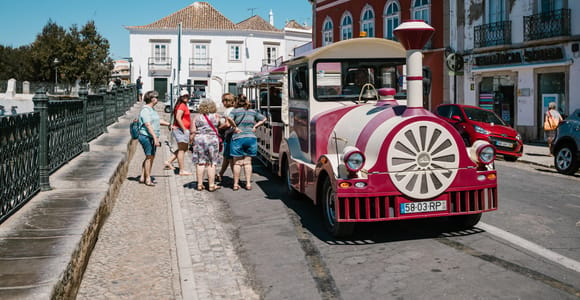
You can compare Tavira’s old-town tours by format. A vehicle-based visit can cover more ground, but it does not automatically give you time to stand beside the bridge and discuss its construction. Ask about stops, not just the route drawn on a map.
Children and visitors who need a slower pace
For children, turn the stop into a concrete observation: count the arches from the bank, then notice what disappears from view when you stand above them. That is an optional activity, not a claim about the age at which a child will enjoy history. Keep the riverside edge in mind and supervise according to your child’s needs.
For reduced mobility, separate the bridge stop from the climb towards the castle. Being able to reach a riverside viewpoint does not establish that the whole old-town itinerary suits you. Confirm your chosen route and any guided-tour arrangements directly; our mobility guide sets out the questions to ask.
When this stop will disappoint
Skip a special detour if your sole interest is a securely dated Roman monument. The local historical account does not support selling this bridge that way. Likewise, do not reserve a large block of time expecting an indoor exhibition on the structure itself.
For a first visit to Tavira, though, it is a useful starting point. Before leaving the river, decide which side your next booking is on and check the meeting pin. That small check is worth more than adding another unsourced construction date to your notes.