The cork factory tour: 50 minutes, €17.50, and not actually in Tavira
Updated September 17, 2026 · 5 min read
Cork is the one Portuguese industry a visitor can watch from start to finish in under an hour, and the Algarve has a factory that lets you. The catch is geography: this tour does not begin in Tavira, and no part of it takes place there.
Our catalogue snapshot of 17 September 2026 lists tour 178149 at €17.50 per person for 50 minutes, rated 4.5 from 712 reviews. The provider is Picturesque Journey | Algarve Rotas. The booking page gives the meeting point as the Eco-Cork Factory at Mesquita Baixa, 8150-048 São Brás de Alportel.
Where it really is
São Brás de Alportel sits inland, and the factory’s published coordinates put it roughly eighteen kilometres west of Tavira in a straight line. By road, through the hills, it is meaningfully further and slower than that number suggests. Check a routing app for your own starting point before you decide.
This is the honest answer to a question the plan for this site asked: is there a cork factory tour for Tavira visitors? There is a cork factory tour in the Algarve, it is good, and it is a drive. A tour sold under an Algarve-wide listing is not the same as a tour that departs from your town, and we would rather say so than let the town name in a search result do the work.
The operator adds a practical warning we have not seen elsewhere: the road beside the factory was under construction at the time of writing, and visitors are asked to approach earlier and from the north, via the M517. Treat that as one more reason to leave a margin.
The transport line is worth a question
The booking page lists transportation under what the ticket includes, while simultaneously giving a meeting point at the factory gate. Those two statements pull in opposite directions, and we could not resolve which applies to a given date and option.
Ask before you pay. Specifically: does the price include a pickup, and if so, from where? A tour that collects you somewhere is a different purchase from a tour that begins when you arrive under your own steam. We will not guess on your behalf, because a wrong guess here costs you a car hire or a taxi you did not budget for.
If the answer is that you drive yourself, the visit becomes a stop to build a day around rather than an outing in itself. Fifty minutes is short. Pair it with Loulé or with the hills rather than driving out and back for it alone.
What you see in fifty minutes
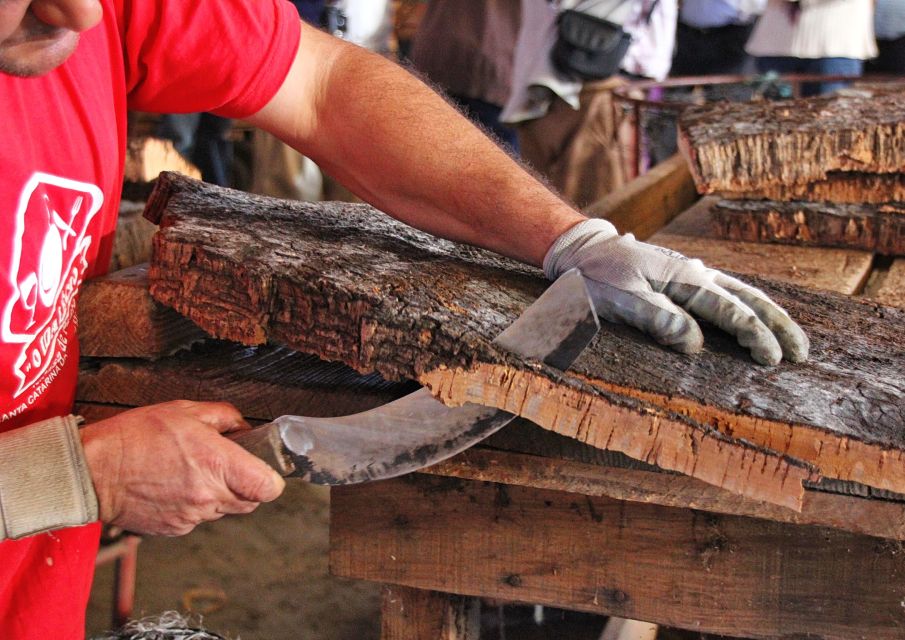
The description covers the traditional processes of preparing and packing cork, how the bark is selected, and the range of things it ends up as. The tour then moves to a shop where cork appears as fabric, bags and accessories — which is a fair part of the point, since cork’s modern life is far wider than bottle stoppers.
The listed languages are English and Portuguese with a live guide, while the written description also mentions an audio guide tour. Ask which format you will get; recent reviews describe a guide talking and answering questions rather than a headset.
The operator’s own description puts Portugal’s cork forest at more than 720,000 hectares. Published figures from the industry side run slightly higher, at around 730,000 hectares and roughly half the world’s cork production. We quote both rather than pick the flattering one.
The nine-year rhythm behind it
Cork is bark, not timber, and the tree survives being stripped. The harvest cycle commonly cited for Portugal is nine years, with the stripping done by hand between roughly mid-May and the end of August, when the bark separates most cleanly. A cork oak can be worked this way many times across a very long life.
Portuguese cork oaks are a legally protected species and may not simply be felled; the protection is set out in Decreto-Lei 169/2001. That protection is the reason the landscape behind the eastern Algarve looks the way it does, with the same trees standing in the same places for generations — something you will notice on any drive inland, including the jeep routes that appear in the things to do around Tavira listings.
Do not expect to see stripping on your visit unless you come in high summer, and do not expect the factory to promise it. The tour is about what happens to the bark after it arrives.
Access, children and the shop
The booking page states that the activity is wheelchair accessible. That is an operator classification rather than a description of every doorway, so anyone with specific requirements should confirm details directly; our wheelchair guide to Tavira covers how we treat such claims generally.
No minimum age appears in our statistics. Operators set their own limits and state them on the booking page. Fifty minutes is a length most children manage, and reviewers describe the visit as interactive rather than a walk past exhibits. The heat inside is real, though: a verified review from July 2026 opens by saying the factory was hot.
The shop at the end is the moment most visitors spend more than the ticket cost. That is not a criticism; it is simply worth knowing before you arrive with a strict budget and a family.
Who it suits
Take it if you have a car, an interest in how ordinary things are made, and an afternoon in the hills already planned. Skip it if you are in Tavira without a car, if fifty minutes will not justify the journey to you, or if you were hoping to see trees harvested rather than bark processed. For a comparable food-and-craft visit that actually sits in Tavira, the table olive factory is the nearer alternative.